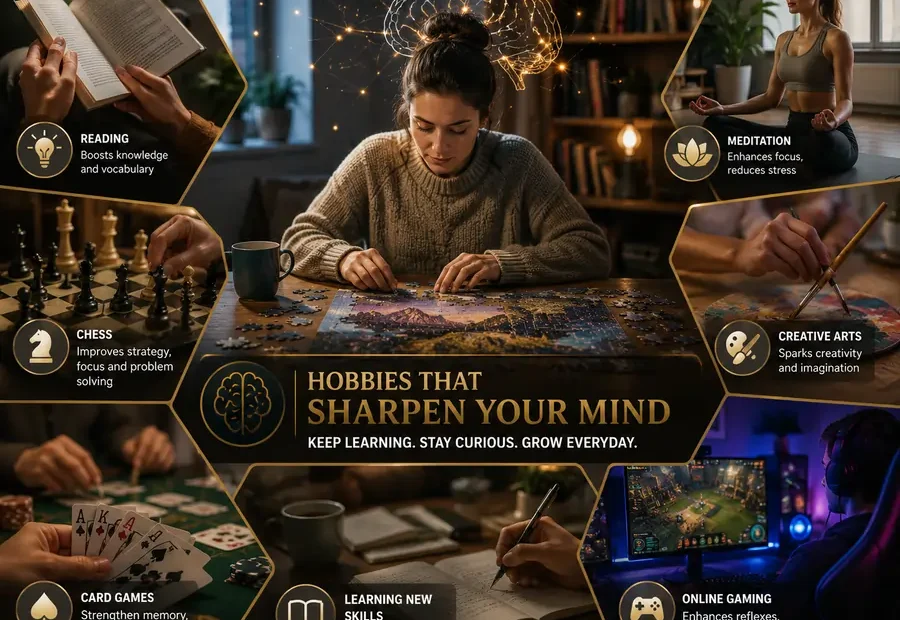
Not all hobbies are created equal when it comes to mental stimulation. Some are wonderfully relaxing and meditative, requiring little active thought. Others push your brain in ways that build genuine cognitive skills over time. If you are looking for a pastime that delivers both enjoyment and a genuine mental workout, the options are more varied than you might expect. From the quiet satisfaction of completing a complex jigsaw to the fast-paced decision-making of online card games, mind-sharpening hobbies span every budget, environment and skill level.
At maker.ie, the focus has always been on helping people find and develop hobbies that genuinely reward the time invested in them. This guide explores some of the best options for those who want their leisure time to leave them feeling sharper, not just rested.
Why Mental Stimulation Matters in Your Hobbies
Research consistently shows that keeping the brain active through challenging leisure activities has measurable benefits. Hobbies that require strategic thinking, pattern recognition, memory or rapid decision-making help maintain cognitive flexibility across all age groups. For younger adults, they build skills that transfer to professional and academic life. For older adults, they are associated with a reduced risk of cognitive decline.
The key ingredient is challenge. A hobby that once required active thought but has become entirely automatic no longer delivers the same mental benefit. The brain adapts to familiar tasks and stops working as hard. This is why the best mind-sharpening hobbies are ones with genuine depth: you can always find a harder puzzle, a stronger opponent, a more complex technique or a new variation that keeps the challenge alive.
This is also why hobbies that combine multiple cognitive demands tend to be particularly effective. A hobby that requires memory, planning, social reading and rapid calculation engages more of the brain simultaneously than one that demands only a single skill. As we will see, several popular pastimes do exactly this.
Jigsaw Puzzles and Spatial Reasoning
Jigsaw puzzles have enjoyed a significant resurgence in popularity in recent years, and the cognitive case for them is well established. Completing a jigsaw requires sustained attention, spatial reasoning, pattern recognition and the ability to hold multiple possibilities in mind simultaneously. These are not trivial demands. A challenging puzzle of a thousand pieces or more can occupy a trained mind for hours without ever feeling routine.
The progression available in jigsaw puzzling is one of its underrated qualities. A beginner can start with simpler images and lower piece counts and gradually work toward more complex compositions and higher piece numbers. Puzzles with abstract or photographic subjects rather than clear outlines present a very different cognitive challenge from those with obvious structural cues. The hobby scales with the hobbyist in a way that keeps the mental engagement alive over years of practice.
Beyond the cognitive benefits, puzzles offer a rare quality in modern leisure: they require complete presence. You cannot scroll, check notifications or half-watch television while working on a complex section. The focus they demand is, for many people, a welcome break from the fragmented attention that digital life encourages.
Chess and Strategy Board Games
Chess is probably the most studied hobby in terms of its cognitive effects. Decades of research have confirmed what chess players have always known intuitively: the game builds planning ability, pattern recognition, working memory and the capacity to think several steps ahead. It also develops resilience, the ability to recover composure after a mistake and continue playing at a high level, which is a skill that transfers well beyond the board.
The modern chess world is more accessible than ever. Online platforms allow players to find opponents at any time of day, at any skill level, for games of any duration from three-minute blitz games to hour-long classical matches. Chess.com and Lichess have millions of active users, and both offer extensive learning resources for players at every stage. Getting started requires nothing more than a device and an internet connection.
For those who want variety, the broader category of strategy board games offers remarkable depth. Games like Go, Shogi, Backgammon and modern designer games like Terraforming Mars or Wingspan combine strategic planning with enough complexity to keep experienced players engaged for years. Many of these games have active online communities and dedicated apps that make finding opponents and learning the rules straightforward.
Card Games: From Bridge to Online Casino Gaming
Card games occupy a fascinating place in the landscape of mind-sharpening hobbies. At their best, they combine probability calculation, memory, strategic decision-making and, in multiplayer formats, the reading of other players’ behaviour and tendencies. These demands are not trivial. Bridge, for example, is considered one of the most cognitively demanding card games ever devised, requiring partnership communication, bidding strategy and real-time calculation across every hand.
Poker rewards a different but equally demanding set of skills: the ability to assess probability quickly, manage risk across a session, read opponents and maintain emotional discipline in the face of short-term variance. These are skills that serious players spend years developing, and the game has a depth that beginners rarely appreciate from the outside.
Online casino platforms have made card games and casino classics accessible to a much wider audience. Draculabonus.co.uk is one such platform, offering a broad range of casino games including card games, table games and slots that can be played from any device. For those who enjoy the mental engagement of card games without the need to organise a physical game, online platforms provide a convenient alternative. As with all gambling, responsible play is essential: set a budget before you start and stick to it.
Learning a Musical Instrument
Learning to play a musical instrument is one of the most comprehensively beneficial hobbies available from a cognitive standpoint. It simultaneously engages motor coordination, auditory processing, memory, pattern recognition and emotional expression in a way that few other activities can match. The research on music and the brain is extensive and consistently positive: musicians show structural differences in the areas of the brain associated with auditory processing, motor control and executive function.
The good news for adults who never learned an instrument is that it is never too late to start. The learning curve is steep at the beginning, which is precisely where the cognitive benefit is greatest. The brain works hardest when acquiring new skills, and the initial months of learning an instrument, when every chord change requires conscious effort and every rhythm feels unfamiliar, are among the most cognitively demanding experiences available in leisure time.
Guitar, piano and ukulele are the most popular starting instruments for adults, partly because of the abundance of free learning resources available online. YouTube tutorials, apps like Yousician and structured online courses mean that it is possible to make significant progress without ever taking a formal lesson, though a teacher can accelerate development considerably.
Language Learning
Learning a new language is perhaps the most researched cognitive hobby of all. Bilingualism and multilingualism are associated with delayed onset of dementia symptoms, improved executive function and enhanced ability to switch between tasks. The brain of a language learner is constantly working: processing new grammar rules, storing vocabulary, mapping new sounds to new meanings and building the ability to think in a different structure entirely.
Modern language learning tools have made the hobby more accessible than at any previous point in history. Duolingo, Babbel, Pimsleur and Anki offer structured learning paths for dozens of languages. Immersive approaches using films, podcasts and books in the target language accelerate progress significantly once a basic foundation is established. Finding conversation partners through platforms like Tandem or iTalki brings the social dimension that formal study often lacks.
For Irish learners in particular, Irish itself is a fascinating and rewarding language to study. It is part of the Celtic language family with a grammatical structure quite different from English or continental European languages, and learning it connects the learner to a rich literary and cultural tradition that is genuinely distinctive.
Coding and Programming
Coding has emerged as one of the most practically valuable hobbies of the past two decades, and its cognitive demands are substantial. Writing code requires precise logical thinking, the ability to break complex problems into manageable components, attention to detail and the patience to debug solutions that do not work as intended. These are demanding cognitive tasks that engage the prefrontal cortex intensively.
The hobby scales from complete beginner to expert in ways that keep the challenge alive indefinitely. Scratch and Code.org provide gentle introductions for absolute beginners. Python is widely recommended as a first programming language for adults. From there, the paths diverge: web development, data science, game development, automation and many other specialisations offer years of increasing depth and complexity.
Coding also has a practical payoff that many hobbies do not. Skills developed in leisure time can translate directly into professional value, freelance income or the ability to build tools and projects that solve real problems. For those who want a hobby that sharpens the mind and potentially opens new career doors, it is hard to find a better option. For further reading on the cognitive benefits of mentally stimulating hobbies, the Alzheimer Society of Ireland’s brain health resources offer accessible, evidence-based guidance on keeping the brain healthy through active leisure.